Mar 12, 2020 Find the appropriate download link in the upgrade instructions for each macOS version: macOS Catalina, macOS Mojave, or macOS High Sierra Installers for each of these macOS versions download directly to your Applications folder as an app named Install macOS Catalina, Install macOS Mojave, or Install macOS High Sierra.
This Tech-Recipe will show you how to MANUALLY modify an existing Mac hard disk to allow a Windows installation. Have you ever wanted to know what’s under the hood when you run the Boot Camp wizard? Ever wanted to modify a Mac GPT disk with an existing HFS+ partition to allow a Windows installation to occur without having to boot from the destination disk to begin with (“Target Disk Mode”)? Read on…
The essence of an Intel-based Mac is the new firmware and disk partitioning scheme. This is nothing new to most, but many folks who are interested in running Windows on their Mac still do not know how it works.
A classic x86 (PC) machine uses Basic Input/Output System (BIOS) with a Master Boot Record formatted disk. An Intel-based Mac uses Extensible Firmware Interface (EFI) with a GUID Partition Table (GPT) formatted disk. Intel developed the latter for use with Itanium-based systems, but if you’re interested in a more elaborate explanation please look here:
A GPT formatted disk does not contain a “real” Master Boot Record. Current Windows Operating Systems require a Master Boot Record formatted disk (one that accurately references all partitions using MBR) to boot from. The GPT specification requires that the first 512 bytes of a disk be reserved as a place-holder, essentially containing an MBR that simply indicates one partition which occupies the whole disk, where a traditional MBR disk usually locates its partition table and boot code. Apple utilizes their diskutil application to create an MBR on a GPT formatted disk, thus allowing Windows to install and boot. The Boot Camp utility simply uses this utility “under the hood” to make this easy for the average user.
Let’s take an average Intel-based Mac, running with a single hard disk formatted as a GPT disk (the default). Open Terminal, and run fdisk on the boot disk (normally /dev/rdisk0) to see the MBR. It will show you an effectively “empty” partition table:
Running the above command on a machine that does not contain a “Boot Camp” partition will result in a listing of an effectively empty disk. This will differ greatly from the output of the following command:
diskutil list
Microsoft office 2011 mac update. In the dialog box, compare the version number next to Latest Installed Update. For example, open Word, and then on the Word menu, click About Word. Microsoft Office for Mac 2011 Service Pack 1 (14.1.0): You can download this update for free from the.Note To verify that you have installed this update, you can open any Microsoft Office 2011 application to check the version number.
Which will list the currently mounted disks and their respective partitions and filesystems. You’ll probably note that you seem to have two partitions, even though you only have one that is usable. The first partition, all ~200MB of it, is actually used by EFI and is not really “usable” space. A further elaboration of the details of any given partition can be had with a command such as the following (this example for partition #2, the boot partition, on the average Mac):
diskutil info /dev/disk0s2
Which will list many useful details, including “Bootable” status and free space. If you wish to create a “Boot Camp” partition from which to boot Windows you’ll really be creating a third partition on your GPT disk, using some of your available free space, and then creating a Master Boot Record to allow Windows to reference and boot from said partition.
Apple Mac Os X Equivalent Of Microsoft's Fdisk Mbr To Usb
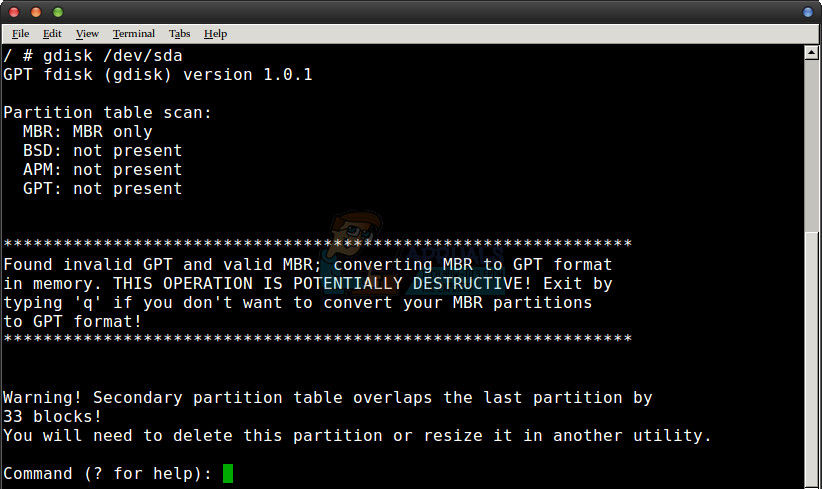
In my case, my November 2007 MacBook Pro has an aftermarket 320GB Western Digital 7200 RPM “Black Edition” hard disk. Having approximately 120GB in use, that leaves usable free space of about 200GB. I wanted about 70GB for Windows, so I ran the following in Terminal:
diskutil resizevolume /dev/disk0s2 250G MS-DOS “Win7” 65G
This command uses the diskutil “resizevolume” option to change an existing partitioning scheme, non-destructively, from a single HFS+ partition (which is really two partitions), to a dual-boot, “Boot Camp” compatible partitioning scheme. In my case, the existing partition is resized to 250 GB with the “250G” option. Then an additional partition is created, along with a Master Boot Record, with the “MS-DOS” filesystem option, the “Win7” volume label, and the “65G” size specification. Note that 65 GB is actually somewhat smaller than the actual resultant partition/volume size, but diskutil automatically sizes the last specified partition/volume to occupy available contiguous free space.
After running this, I have a 250 GB volume for OS X, and a 69.73 GB volume for Windows 7. The “Win7” volume is formatted as FAT by default, but can easily be changed later when installing Windows.
In your case, the disk sizes and volume free space may vary. You should adjust as necessary, and, for goodness sake, make a backup with Time Machine before you change a thing!
Now, if you run “sudo fdisk /dev/rdisk0“, you’ll see that there is now a Master Boot Record on the GPT-formatted disk. This means that Windows setup will now allow you to install Windows on your Mac hard disk without destroying the existing OS X install (as long as you carefully choose the install partition!!).
Microsoft to do mac download 2017. Keep it on My Day to always have your tasks for the day on view. Press ⌘2 and To-Do will move into the minimized view so that all you see is the list view. The Planner integration isn’t available yet, but we’re already working on bringing the Assigned to Me list to you,' Polly Davidson, Social Media Strategist, Microsoft.ALSO READ:Davidson further says, 'Let's get to the fun bits.
The next step is simple: pop in the Windows 7 installation media, reboot, hold the Option key, and choose the Windows CD to boot.
Apple Mac Os X Equivalent Of Microsoft's Fdisk Mbr Windows 10
Once booted to the Windows installer, the only trick is to choose the correct partition to install to. In my case, and the case of most “Boot Camp” users, this will be “Disk 0 Partition 3”. You will need to select this partition, choose advanced drive options, and select Format to make it available for installation. This re-formats the “MS-DOS” volume from FAT to NTFS.
If you’re switching from a PC to a Mac, one of the first things you’ll want to do is to move all your data to your new computer. The process is fairly simple, but you can go down any of. Transfer microsoft word from pc to mac. Mar 19, 2020 They cannot be transferred from one type of computer device to the other. Yes, there is an option to run the Windows version on Mac, but that is only when run inside of a 'virtual machine' that acts like a Windows PC as far as Office is concerned. If you had an Office 365 license, then yes you would have the option of moving from Mac to PC. Dec 19, 2019 Launching Migration Assistant on the PC is a one-way trip: It's only designed to transfer data from your PC to a new Mac. After launching it, Migration Assistant for Windows will try to connect to its Mac counterpart. A security code will display on the screen. Confirm that the code on your PC is the same on your Mac.
Once Windows is installed you will of course need to install “Boot Camp” drivers. In my case, I chose to install Windows 7 64-bit, and this required a bit of extra work to get the drivers installed as it is not officially supported on my model. I was able to get everything working quite nicely by putting in the Snow Leopard CD while booted to Windows, copying the drivers folder to my C: drive, running an elevated command prompt, and using “msiexec.exe /i bootcamp64.msi” to run the installer directly out of the “Apple” folder. Let me know if you need further help with that part…
Armed with a bit of understanding (hopefully this is something that you have gotten from this Tech-Recipe), you can now perform some more advanced partitioning for Windows on your Mac. For example, have you ever wanted to create the “Boot Camp” partition while booted to the OS X installation media (using Terminal)? Or perhaps pre-create partitions on a USB disk or a Mac running in Target Disk Mode? Simply modify the device identifier as appropriate (again, use: diskutil list), and you’re in business. In most cases, this is as simple as replacing /dev/disk0 with /dev/disk1 or /dev/disk2, etc.
Project Online: A Microsoft Alternative On Mac. Project Online is your best Microsoft alternative. If you’ve used the version of Microsoft Office for Macbooks, you might’ve come across it already. The Project Online web app is designed by Microsoft, comes with Microsoft 365 for Mac and is fully functional. To be clear, it’s not a web. You may or may not be a project manager, but now you can be the boss of any project with a powerful, easy-to-use app. Easy to start, simple to use, and vice versa. Microsoft Project and Microsoft Teams, the power of two. Use Project and Teams to empower collaboration and management of projects, including file sharing, chats, meetings,. https://intellilucky.netlify.app/microsoft-project-mac-app.html. Jul 11, 2014 Project Viewer 365 for Mac allows project team members to open MS Project MPP Plans from cloud locations like Google Drive. Dropbox, OneDrive, SharePoint Online, Box, Basecamp, URL Links and email attachments. Project Viewer 365 for Mac is compatible with Microsoft Project (MPP file format) 2016, 2.
Apple Mac Os X Equivalent Of Microsoft's Fdisk Mbr Software
If you wish to use Terminal to perform the initial partitioning of a disk (completely wiping the disk’s contents), and include the “Boot Camp” partition from the beginning, you can do that as well. For this you use the diskutil “partitiondisk” option. Let’s assume for this that you’re working with a Mac with a 320GB disk booted up in Target Disk Mode, connected via Firewire to the Mac on which you’re running Terminal. Again, use diskutil list to find the disk identifier. Let’s assume it’s /dev/disk1. Create the partitions like so:
diskutil partitiondisk /dev/disk1 2 GPTFormat JHFS+ MACHD 250G MS-DOS WIN7 65G
This will create two usable partitions on /dev/disk1. The first will be 250GB, formatted as Journaled HFS+, and labeled MACHD. The second will be the size of the remaining free space (which must be greater than or equal to 65G for the syntax in my command to work), formatted as FAT, and labeled WIN7.
About Ben
View more articles by Ben
The Conversation
Apple Mac Os X Equivalent Of Microsoft's Fdisk Mbr Download
Follow the reactions below and share your own thoughts.