Mac OS X 10.6 Snow Leopard. Mac OS X 10.6 Snow Leopard was billed as primarily under-the-hood changes to OS X 10.5 Leopard, but it was much more significant than that. Snow Leopard was announced at the June 2008 Worldwide Developer Conference (WWDC) and released on August 28, 2009.
- Microsoft word 2004 for mac os x 10 6 free download - Apple Java for OS X 10.6, Apple Mac OS X Snow Leopard, Mac OS X Update, and many more programs.
- Paragon ntfs for mac os x snow leopard free download - Apple Mac OS X Snow Leopard, Paragon NTFS for Mac Special Edition, Paragon NTFS for Mac, and many more programs.
Mac OS X 10.6 Snow Leopard was billed as primarily under-the-hoodchanges to OS X 10.5 Leopard, butit was much more significant than that.
Snow Leopard was announced at the June 2008 Worldwide DeveloperConference (WWDC) and released on August 28, 2009.
For the first time since Mac OS 8.5 had been released in October1998, Apple left behind an entire processor architecure. Back then, itleft behind the Motorola 680x0 CPUs in favor of PowerPC (the first PPCMacs had been introduced in March 1994). With 10.6, Apple left behindPowerPC CPUs in favor of Intel (the first Intel Macs were introduced inJanuary 2006).
Big Changes with 10.6
- Snow Leopard is smaller than Leopard. By removing PowerPC and otherunnecessary legacy code, Apple greatly reduced the drive space neededby the operating system. It takes up about half as much space and thuswill install about twice as fast as Leopard. That said, it makes moredemands of your hardware, so a Mac that runs Leopard comfortably with 1GB of memory may feel very sluggish with Snow Leopard once you havemore than a couple apps running. We strongly recommend at least 2 GB ofmemory for 10.6.
- Grand CentralDispatch (GCD) means that the entire operating system is designedto take advantage of multiple cores, whether on one chip or more thanone. Process threads, which were handled by apps in the past, are nowhandled by the OS with new programs designed to use GCD. GCD willassign only as many threads to an app as it currently needs, whichmakes for better use of resources.
- Full 64-bitsupport means programs will no longer be limited to 4 GB of RAM;the new maximum (16 exabytes) is meaningless, as no computer in theforseeable future will be able to hold billions of gigabytes of memory.Both the OS and almost all 'system applications' (Finder, Safari, Mail,iChat, iCal, etc.) are ready for 64-bit operation. And Snow Leopard iscompletely backwards-compatible with 32-bit apps. First generationIntel Macs designed around Intel Core Solo and Core Duo chips do notsupport 64-bit operation; all Macs since then do.
- OpenCL takesadvantage of powerful modern graphic processing units (GPUs, a.k.a.'video cards') for more than displaying video. All of that processingpower will also be available for general purpose computing.
- QuickTime Xintroduced a new QuickTime player and will take full advantage of CoreAudio, Core Video, and Core Animation. It can record audio and videousing your Mac's built-in microphone and webcam, and it can trim andexport for iPod, iPhone, Apple TV, YouTube, and MobileMe so you don'tneed to worry about which codec to use. QuickTime X supports HTTP livestreaming, which can adjust quality on the fly based on availablenetwork bandwidth. Of course it takes advantage of GCD and 64-bitoperation.
- ExchangeSupport is built right into the OS. Mail, iCal, and Address Bookwill work with Microsoft Exchange Server 2007. This may explain whyMicrosoft finally brought Outlook to the Mac with Office 2010. So long,Outlook.
- The Finder has been completely rewritten to support 64-bitoperation and take advantage of Grand Central Dispatch. This makes theFinder much more responsive.
- For the first time, the Services menu is contextual: You will onlysee the services available to the current app. (Until now, half or moreof the Services might be grayed out because they don't work with yourcurrent program.)
- Exposé can work in the Dock - click and hold an applicationicon and it will display that app's active documents in a grid. Appleclaims this will make it 'even easier to find what you're lookingfor.'
- Time Machine backups are up to 50% faster, according to Apple. Thiswill be especially helpful for that first, long, full backup.
- Macs shut down and wake up more quickly, and joining a WiFi networkis also faster. This makes for more energy efficient file sharing -your sleeping Mac uses less energy and wakes more quickly to serve upfiles.
- If you travel with you're Mac, you'll appreciate automatic timezone settings.
- The 'Wake on Demand' feature may keep your Mac from staying asleep.The fix is to reset the Energy Saver settings to their defaults, thenput in your own settings.
Things Lost with 10.6
- There is no support for LocalTalk/AppleTalk in Snow Leopard. You'llneed to find another way to connect those old printers.
- There is no longer any support for Palm OS devices in iSync. TheMissing Sync (commercial software) does support Palm devices.
- Snow Leopard ignores creator codes when launching documents,something every Mac OS prior to 10.6 has supported - it's beenpart of the Mac OS since the beginning.
- There is no write support for HFS+ volumes (floppies, hard drives,etc.)
Snow Leopard was replaced with OS X 10.7 Lion on July 20, 2011 afterjust 11 months at the helm.
Minimum Hardware Requirements
- Intel-based Mac
- 1 GB of RAM, although 2 GB is strongly recommended
- 5 GB of available drive space
- DVD-compatible optical drive
- Grand Central Dispatch requires a dual-core CPU
- 64-bit support requires a Core 2 or newer CPU
- OpenCL is compatible with all current Macs. It is not compatiblewith:
- iMacs released before March 2009
- Mac mini released before March 2009
- MacBook released before October 2008
- MacBook Pro released before June 2007
- Mac Pro released before January 2008 (Jan. 2008 and later modelswith unsupported video cards can used the discontinued GeForce 8800upgrade kit - Apple part no. MB137Z/A - for OpenCL support. The GeForce GT 120 retails for $149, is designed to work with the 2009Mac Pro and has been reported to work with the 2008 model as well.)
Further Reading
- New iMacs and MacBooks soon?, Blu-rayon Macs, looking back at Lisa and Mac Plus, and more, Mac NewsReview, 09.25. Also Snow Leopard sales data, using FreeHand andAppleWorks with Snow Leopard, affordable Pentax K-x DSLR even comes inred, and more.
- Cheap USB 2 CardBus solution, OS 9and Kanga, mobile Mac value, and more, Charles Moore, MiscellaneousRamblings, 2009.09.09. Also a look at several options for using an oldLocalTalk printer with a Mac running Mac OS X 10.6 Snow Leopard.
- 100 apps incompatible with 'SnowLeopard', Mac mini and SuperDrive firmware updates, and more, MacNews Review, 2009.09.04. Also August market share changes, retrieving astuck disc, anti-malware in Snow Leopard, USB 3.0 certification begins,and more.
- Wake on demand in Snow Leopard,extended repair policy for MacBook Air hinges, big drives, andmore, The 'Book Review, 2009.09.04. Also Windows 7 great on aMacBook Pro, gScreen preparing dual display notebook, free OS X 10.6deal from QuickerTek, bargain 'Books from $179 to $2,294, andmore.
Downloadable Updates
Standalone Updates let you update to a newer version of Mac OS Xfrom your hard drive instead of using Software Update, which requiresan Internet connection. Download the one(s) you need and install themafter mounting the disk image and launching the Installer program.
There are two types of Standalone Updates: Individual (or Delta) andCombo.
- Individual Updates update one version of Mac OS X to thenext version. For example, the Mac OS X 10.6.4 Update updates Mac OS X10.6.3 to version 10.6.4. Individual Updates are also known as DeltaUpdates.
- Combo Updates update the base version of a Mac OS X releaseto the version specified in the Combo Update, including allintermediate updates. For example, the Mac OS X 10.6.4 Combo Updateupdates any earlier version of Mac OS X 10.6 to Mac OS X 10.6.4 using asingle installer, as opposed to installing the individual Mac OS X10.6.1, 10.6.2, 10.6.3, and 10.6.4 updates.
Standalone Updates are generally available 24 to 48 hours after theUpdate is available through Software Update.
If you burn a Standalone Update to CD, its disk image must be copiedto your desktop or another location on your Mac OS X startup disk inorder to be installed.
This page will be updated as new Standalone Updates becomeavailable.
Mac OS X 10.6.1
Mac OS X 10.6.2
Mac OS X 10.6.3
Mac OS X 10.6.4
Mac OS X 10.6.5

Mac OS X 10.6.6
Version 10.6.6 introduced the Mac App Store.
Mac OS X 10.6.7
Mac OS X 10.6.8
Low End Mac is an independent publication and has not been authorized,sponsored, or otherwise approved by Apple Inc. Opinions expressed arethose of their authors and may not reflect the opinion of CobwebPublishing. Advice is presented in good faith, but what works for onemay not work for all.
Entire Low End Mac website copyright ©1997-2016 by Cobweb Publishing, Inc. unless otherwise noted. Allrights reserved. Low End Mac, LowEndMac, and lowendmac.com aretrademarks of Cobweb Publishing Inc. Apple, the Apple logo, Macintosh,iPad, iPhone, iMac, iPod, MacBook, Mac Pro, and AirPort are registered trademarks of AppleInc. Additional company and product names may be trademarks orregistered trademarks and are hereby acknowledged.
Please report errors to .
LINKS: We allow and encourage links toany public page as long as the linked page does not appear within aframe that prevents bookmarking it.
Email may be published at our discretion unless marked 'not forpublication'; email addresses will not be published without permission,and we will encrypt them in hopes of avoiding spammers. Letters may beedited for length, context, and to match house style.
PRIVACY: We don't collect personalinformation unless you explicitly provide it, and we don't share theinformation we have with others. For more details, see our Terms of Use.
Follow Low End Mac on Twitter
Join Low End Mac on Facebook
Favorite Sites
MacSurfer
Cult of Mac
Shrine of Apple
MacInTouch
MyAppleMenu
InfoMac
The Mac Observer
Accelerate Your Mac
RetroMacCast
The Vintage Mac Museum
Deal Brothers
DealMac
Mac2Sell
Mac Driver Museum
JAG's House
System 6 Heaven
System 7 Today
the pickle's Low-End Mac FAQ
Affiliates
Amazon.com
The iTunes Store
PC Connection Express
Macgo Blu-ray Player
Parallels Desktop for Mac
eBay
Advertise
All of our advertising is handled by BackBeatMedia. For price quotes and advertising information,please contact at BackBeat Media(646-546-5194). This number is for advertising only.
System Requirements for Snow Leopard vs Leopard
- Snow Leopard (Mac OS X v10.6) only runs on Intel-based computers and not the older PowerPC chips.
- An upgrade from Leopard to Snow Leopard frees up about 7GB of hard disk space. This has more to do with removing redundant components like printer drivers (which are downloaded on demand in Snow Leopard) than removing code specific to PowerPC.
Speed and Performance in Snow Leopard
Apple has made operating system components faster with Snow Leopard. Performance improvements include
- Faster startup, shutdown, installation, Time Machine backup and connection establishment.
- Faster PDF and JPEG icon refreshes.
- Improved performance of Finder, which has been rewritten in 64-bit Cocoa
Refinements to the user interface in Mac OS X 10.6 (Snow Leopard)
There was no major overhaul of the existing Leopard interface when Apple introduced Snow Leopard. Minor UI refinements include:
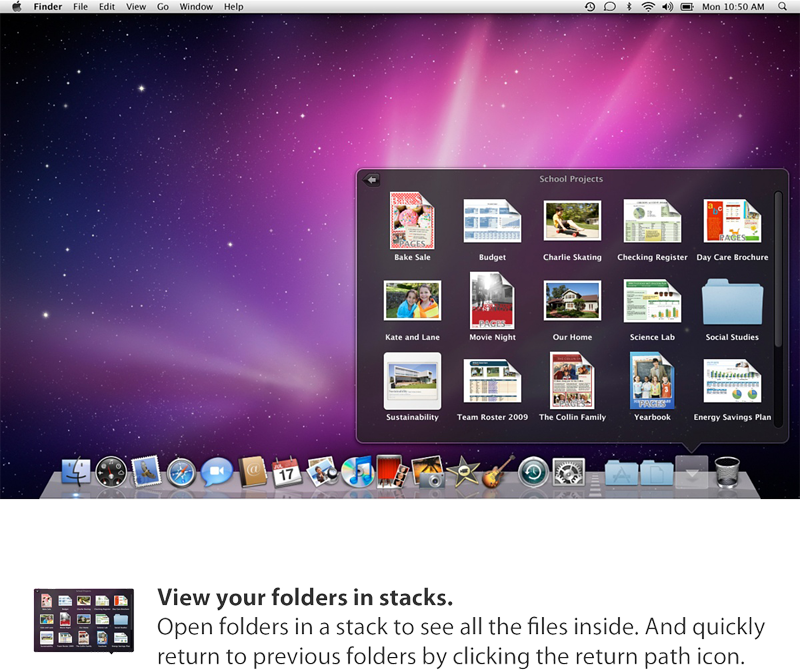
- Stacks in Snow Leopard allow viewing a subfolder without launching Finder. Stacks have also been modified to include scroll-bars for folders with many files.
- Contextual menus which come out of Dock icons have more options and have a new look, with a semi-transparent charcoal background and white type.
- Exposé can display all windows for a single program by left clicking and holding its icon in the dock.
- Selection of columned text in PDF documents by analyzing the page layout.
- Prefixes for bytes are now used in strictly decimal meaning when describing disk space, such that an indicated file size of 1 MB corresponds to 1,000,000 bytes.
- There’s now a Put Back command in the Trash, just as in Windows’ Recycle Bin.
- You can page through a PDF document or watch a movie right on a file’s icon.
- When you click a folder icon on the Dock, you can scroll through the pop-up window of its contents.
- Buggy plug-ins (Flash and so on) no longer crash the Safari Web browser; you just get an empty rectangle where they would have appeared.
- Snow Leopard also has an impressive trove of tools for blind Mac users, including one that turns a Mac laptop’s trackpad into a touchable map of the screen; the Mac speaks each onscreen element as you touch it.
- When you rename an icon on an alphabetically sorted desktop, it visibly slides into its new alphabetic position so you can see where it went.
New Features in Snow Leopard vs OS X Leopard
- WiFi signal strength: AirPort in OS X Snow Leopard displays the signal strength for all available WiFi networks so you can choose the strongest possible connection.
- Sortable search results: Snow Leopard adds the ability to sort Spotlight search results by name, date modified, date created, size, type of file, or label.
- Annotations in Preview: New annotation tools in Preview allow users to annotate and markup PDF files, including comments, links, highlighting, strikethrough text, shapes, text, and arrows.
- Cisco VPN support: Snow Leopard has built-in support for Cisco VPN connectivity. This allows users to connect securely with corporate networks (if the network uses Cisco VPN) without needing any additional software.
- Automatic update for printer drivers: When connecting to a printer, Snow Leopard downloads the most current device driver for the printer from the Internet. The new OS X also periodically checks for updates to the printer driver via Software Update.
- Nearby printers: When printing Snow Leopard displays the printers that are detected nearby, enabling you to identify and configure the best available device for printing your document.
- HFS+ read in Boot Camp: When using Windows (via Boot Camp) users can now access (read-only) files on the 'Mac side' without rebooting.
Support for Microsoft Exchange
Mac OS X Snow Leopard includes out-of-the-box support for connecting to Microsoft Exchange 2007 servers for access through Mail, Address Book, and iCal. Neither Microsoft Windows nor older versions of Mac OS X included this feature.
64-bit addressing
Mac OS X Snow Leopard and most Mac OS 10.6 built-in applications have been rebuilt to leverage the 64-bit addressing space (excluding iTunes, Front Row, Grapher and DVD Player applications), since Apple has started shipping each Mac as a 64-bit system. Snow Leopard supports up to 16 terabytes of RAM.
Grand Central Dispatch in OS X v10.6
Grand Central Dispatch utilizes multiple processor cores for more efficient performance. Due to the technical difficulties involved in making multi-core-optimized applications, the majority of applications do not effectively utilize multiple processor cores. As a result, processing power often goes unused. Grand Central Dispatch includes APIs to help programmers efficiently use these cores for parallel programming.
OpenCL
Introduced in Snow Leopard, OpenCL (Open Computing Language) addresses the power of graphics processing units to leverage them in any application, and not just for graphics-intensive applications like 3D games. OpenCL automatically optimizes for the kind of graphics processor in the Mac, adjusting itself to the available processing power.
QuickTime X
In Mac OS X v10.6, Apple has redesigned the QuickTime user interface to resemble the existing QuickTime full-screen view, where the entire window plays only the video and all controls including the title bar fade in and out as needed.
QuickTime X supports HTTP live streaming. Thus, QuickTime X streams audio and video using any web server instead of a special streaming server, and it works reliably with common firewall and wireless router settings.
QuickTime X uses Mac OS X technologies such as Cocoa, Grand Central Dispatch, and 64-bit computing to deliver higher performance and enables QuickTime Player to launch up to 2.8x faster than QuickTime. QuickTime X also takes advantage of ColorSync to provide high-quality color reproduction.
There is a 'Send to YouTube' command built in when you play movies. Users can also record their screen activity as a movie.
CUPS
CUPS (the printing system in Mac OS X and Linux) has been updated to version 1.4 which provides improved driver, networking, and Kerberos support along with many performance improvements. CUPS 1.4 is also the first implementation of the Internet Printing Protocol version 2.1.